Yeah, what’s the deal with the virtual keyboard!?

- 3 Posts
- 48 Comments
Joined 3 years ago
Cake day: February 1st, 2023
You are not logged in. If you use a Fediverse account that is able to follow users, you can follow this user.
OP has a pascal GPU, the Nouveau kernel drivers for pascal (which you need for nvk) aren’t really suitable because they can’t change the clock at runtime, you are stuck at boot clock (which you can configure)
The comment said that people that install systemd based systems and then fight systemd tools are stupid. In that instance a guy is dead set on using netplan and shell scripts on a system with networkd, when using just networkd would have been extremely simple. Maybe in a system without systemd it would have been easier to use netplan, but the guy decided to install systemd and then fight it, and then suggested other people do the same.
Think harder, I know you can. Maybe reread the comment. Maybe compare those lines with that one line change.
Maybe notice that I specifically said to install a system without systemd if you don’t like it, instead of fighting the tool you installed and then complaining.
 23·1 month ago
Honestly, one of the worst parts of the Linux community is people trying to force 30 years old tools in systems built around systemd. If you want to use that old stuff then don’t install the modern replacement, find a different distro built around that ideal instead.
I remember a post on serverfault or askubuntu about disabling DHCP default gateway but keeping DHCP address assignment on a tap interface, and bring it up at boot, and the accepted answers was “configuring DHCP in networkd/NetworkManager systems is almost impossible, here’s how I did it” and it’s three pages of cobbling together ifconfig and netplan with startup scripts, that work by pure chance.
Wanna see the actual full networkd configuration for that?
# /etc/systemd/network/tap0.network
[Match]
Name=tap0

[Network]
DHCP=ipv4

[DHCPv4]
UseRoutes=false
That’s it, all that the post asked for is handled by six lines. “How do I discover that?” you may ask, because if it’s three lines, but I have to dig for hours before finding it than it’s not that useful. Simple, I go on the systemd documentation for .network files and search for DHCP. And this is a niche use case, the basic usage is readily available on the arch wiki as with anything else. Note, this does nothing for IPv6, and the interface will have IPv6 route configured, but this wasn’t relevant to the post, and my home’s IPv6 layout is “peculiar” so I have omitted it here.
Hmmm, I’m pretty sure you just need to
systemctl disable sshd.socketand then configure it how you like. Don’t trust every “solution” you see online, they are often full of bullshit written by people trying to fit a square peg in a round hole. I bet that kernel parameter thing is something to disable it on the first boot, before you get the chance to configure the thing properly.Edit: @thorhop@sopuli.xyz wrote a comment about that option here, go to the thread if you are interested.
I’m pretty sure no Italian ever said Garibaldi is coming, except in 1860 when he actually was coming. But you could say there weren’t any Italian at the time, as Italy was just made

Nah, you just want feet pics
I know, but maybe it wasn’t what you were looking for

Is Non Binary fine? If so, I loved “love me for who I am”. Bear in mind that it is a romance manga, not a seinen, but it also touches some serious themes.
A third display server would probably be either useless (as in it would not be adopted or development would not takeoff) or just Wayland but without the committee. As such it would only cause more fragmentation. Plus, not anyone has the skills and availability required to make a good display server, and as of now, most of the ones that do are working on Wayland.
P.s. if instead of Wayland like it were x11 like it would stop being “de-facto useless” and become “useless by definition”
UV is a lot more than pipx. It installs applications from pypi, without dependency hell, but it also uses hard links when possible to avoid wasting space. But it’s also a dev tool. It manages python installations, workspaces, you can use it to edit the pyproject, it can also publish to pypi, even from a GitHub action if set up from pypi. It just does a lot more.
Correction, uv isn’t in any way less an option. pypi is only the registry. If you are using pip you will end up in dependency hell, you might use something like poetry to avoid that, but uv is just better.
But… wait a minute… uv is inspired by cargo, and it’s also written in rust. That’s quite the coincidence, huh?
Also, cargo is fast, it’s rustc that’s slow, and that’s because rustc is doing advanced code analysis. Compiling rust is actually NP-hard, but in exchange for that, the compiler will catch bugs in place of the developer. Which is a good tradeoff considering that you only compile once and run many times.
“countless projects that use it that way” isn’t proof of anything. Countless projects tell you to
curla 2000 lines script intosudo bashthat will fill your os with bullshit.
“the compositor takes care of things it shouldn’t” said the x11 user while using their display server that also manages printers, and also provides peripheral drivers, and also manages opengl drivers, and also provides a full graphic toolkit, and also provides remote access. And all that while treating multiple monitors like a single big monitor with a single shared refresh rate, and with no support for HDR of trackpad gestures. Yes, it really is upsetting when the screen compositor manages screen recording and double buffering. And remember x11 is so modular that the graphic server is part of the driver stack and so must be implemented for every GPU out there.
P.s.: anyone that thinks the Unix philosophy has any value should not touch xorg with a 10 meter pole. It does many things, badly. But sure, it does allow any unprivileged program to read and write to the framebuffer, so be my guest if that’s your thing.
That’s also slower than most of the stuff you could come up with, it is so slow that there is no hyperoperation fast enough to describe it. There were other approaches that were almost worse though, like “the function is a switch-case that returns false by default. As complaint tickets are opened, more cases get added to the switch-case”

Please don’t do that, I was stupid when I wrote that. But still, in very dynamic languages like python or js everything is an object, including functions, so you can just do object stuff on them.
The implementation is not very exciting, I capture a variable in python. It could have been done more cleanly.
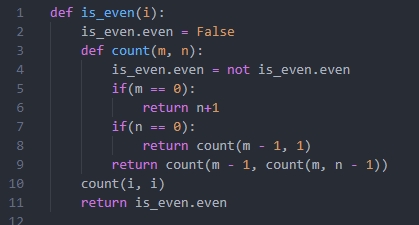
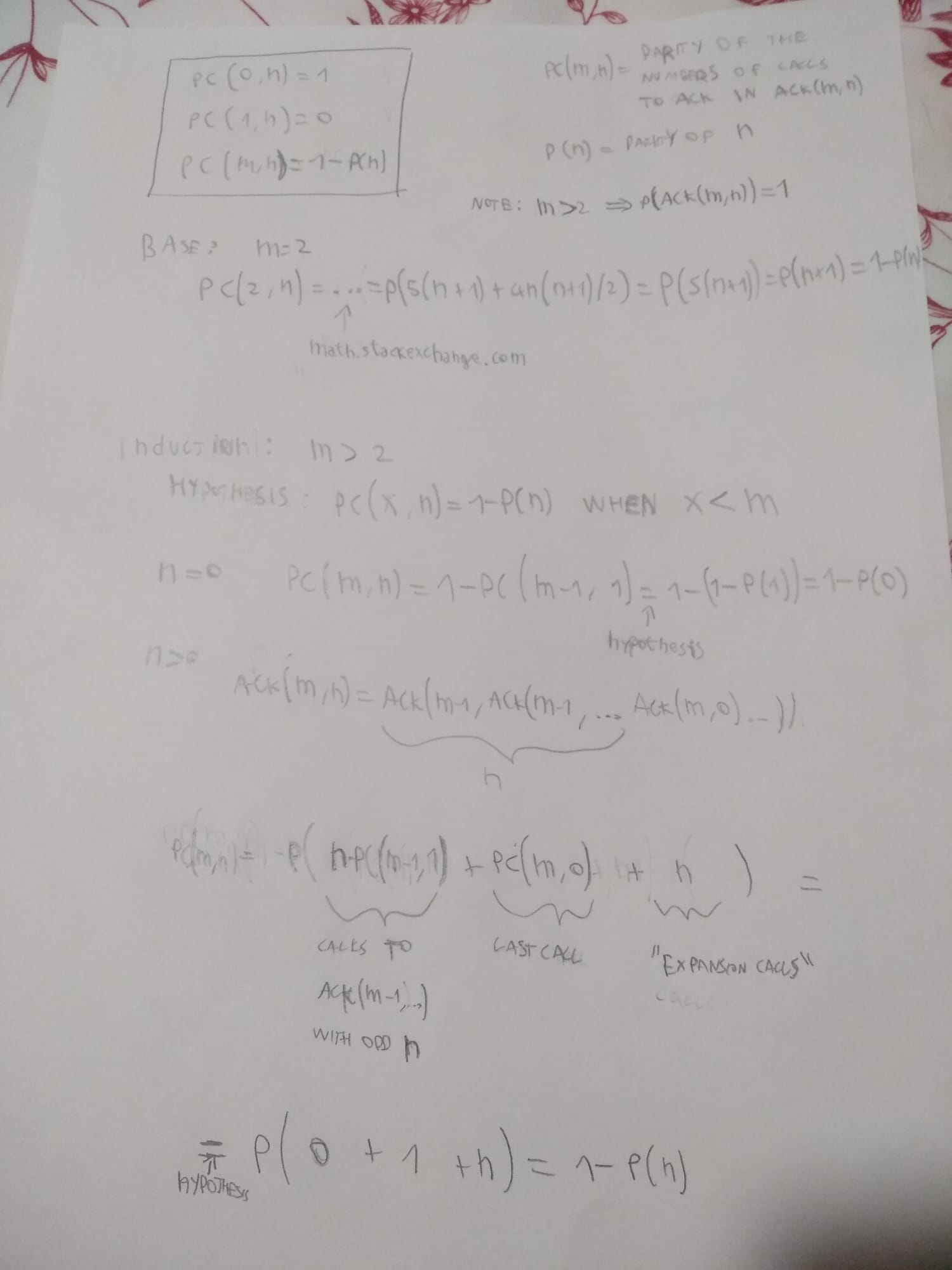
The proof is this. But, I could have made mistakes, it was many years ago.
Note that in python you’ll never be able to run
is_even(5)the stack cannot handle itEdit: daaaamn, that variable is ugly as hell. I would never do things like that now.
For a time on Reddit (some years ago when I still used it) there was a trend of finding the worst way of implementing
is_even(x: int) -> bool. My contribution to that was a function that ranAckerman(x,x)flipping a Boolean at every iteration, and check if it was true or false at the end.It works btw, I will find the proof later
May I interest you in the program I just wrote. I think you might like the subcommand
type.I use it to automatically copy mime types “video” and extensions “.srt” from the Torrent folder to the jellyfin folder. The other two subcommands, I use them to save user dotfiles and system config files on git



That’s… Not what I meant